

Inside Marshall BioResources: Who Owns the Research-Animal Supplier Facing Disturbing New Cruelty Allegations?
A privately held, family-owned company in rural New York supplies beagles and other animals to government agencies, pharmaceutical companies and university researchers. Now a criminal referral is asking New York authorities to investigate allegations of brutal killings and mistreatment inside its facilities. Marshall BioResources denies the accusations.
By Webs411 | September 3, 2026
In North Rose, a small community in Wayne County, New York, sits a company most Americans have probably never heard of.
Its animals, however, have traveled into pharmaceutical laboratories, university research programs and government-funded studies across the United States and around the world.
The company is Marshall BioResources, the research-animal business operated by Marshall Farms Group, Ltd.
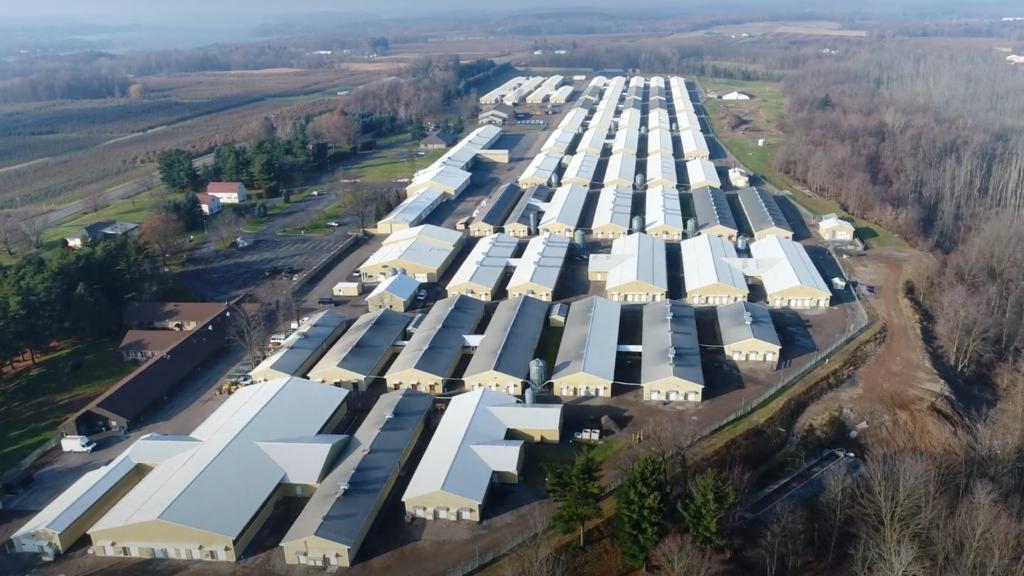
Marshall breeds purpose-bred beagles, ferrets, cats and Göttingen minipigs for biomedical research. The company says it began in 1939, remains family-owned, and maintains animal colonies in the United States, United Kingdom, France and China. Its headquarters are at 5800 Lake Bluff Road in North Rose.
Marshall is not a publicly traded corporation. OSHA records identify Marshall Farms Group’s ownership as private, and federal contracting records list Marshall Farms Group itself as the parent company rather than a pharmaceutical conglomerate or publicly traded corporate owner. In other words, there is no Pfizer, Merck or private-equity giant sitting above Marshall in the corporate chain that we could identify.
A 2022 New York court decision identifies Scott Marshall as president and CEO of Marshall Farms Group. That same case provides an unusually useful look at the company’s structure: Marshall Farms Group was described as a specialty breeder that breeds animals for sale and medical research. The court also found that Marshall Farms Group, Marshall Pet Products and Marshall Ingredients had separate management, boards and day-to-day operations. Marshall Pet Products should therefore not simply be described as the parent company of the research-animal business.
That distinction matters because Marshall BioResources is sometimes portrayed as one arm of a sprawling corporate empire. The available records tell a somewhat different story: it is a large, privately controlled and internationally active animal-breeding business whose ultimate corporate identity leads back to Marshall Farms Group itself.
And its scale is anything but small.
Thousands of Dogs Behind One Company
Recent analyses of USDA inspection inventories put the number of dogs held across Marshall’s New York operations at more than 15,000 during May 2026, in addition to thousands of ferrets, cats and pigs.
One published analysis of USDA inventory records reported 15,078 dogs, 13,959 ferrets, 2,108 pigs and 2,058 cats across the company’s New York sites. At the main North Rose location alone, a May 19 inspection inventory was reported as listing 5,394 puppies, 9,171 adult dogs and 11,706 ferrets. Because Webs411 has not independently obtained every underlying USDA inventory sheet, those specific totals should be understood as figures reproduced from federal inspection records by outside watchdogs and investigators.
A separate database compiling USDA inspection information lists Marshall Farms Group under active Class A breeder license 21-A-0008 and records its most recent breeder inspection as May 19, 2026.
This is not a traditional dog breeder selling puppies to families.
Marshall’s business is supplying animals bred specifically for scientific and biomedical use.
Who Buys Marshall Animals?
The answer reaches into government, academia and the pharmaceutical industry.
Federal contracting records show that the U.S. Department of Defense is doing business with Marshall Farms Group in 2026.
A Defense Health Agency award signed in January 2026 paid Marshall Farms Group $20,125 for items supporting large-animal scientific research. A separate January 23 delivery order worth approximately $32,508 was described as supporting “large animal research for clinical studies.” Both were scheduled to run through September 30, 2026.
Other federal records and previous contracts connect Marshall animals with agencies including the National Institutes of Health and Department of Veterans Affairs. Published military research also documents Göttingen minipigs purchased from Marshall Farms Group for work conducted by the Uniformed Services University and Armed Forces Radiobiology Research Institute.
But government agencies are only one part of the customer trail.
Peer-reviewed scientific literature gives us direct documentation of Marshall beagles entering major corporate and university research programs.
Researchers at AbbVie, for example, reported using 36 male beagles from Marshall BioResources in a canine cardiovascular telemetry program. Another AbbVie-related study describes male and female beagles purchased from Marshall, housed at AbbVie’s animal facility and later euthanized for collection of tissues.
A vaccine study conducted under a Zoetis animal-use protocol states that 60 specific-pathogen-free beagle puppies were purchased from Marshall BioResources in North Rose after weaning. The puppies were between eight and ten weeks old when the vaccination phase of the study began.
A study sponsored by Orion Corporation’s Orion Pharma identifies beagles supplied by Marshall BioResources in North Rose.
Another published study states that nine adult male beagles were procured from Marshall Farms and housed at GlaxoSmithKline’s King of Prussia, Pennsylvania, facility under a GSK-Galvani animal-use protocol.
At the University of Kentucky, researchers conducting work involving aging and Alzheimer’s disease reported that 45 beagles were purchased from Covance/Labcorp and Marshall Farms, both approved Class A vendors for the university’s laboratory-animal program. A 2026 follow-up publication again identifies Marshall BioResources among the suppliers of the dogs used in the research.
These papers establish that the organizations used Marshall animals in particular studies. They should not automatically be interpreted as proof that every organization remains a current Marshall customer in 2026, nor do they implicate those customers in the allegations concerning conditions at Marshall itself.
They do, however, demonstrate how deeply Marshall animals have entered the mainstream biomedical research system.
The New Allegations
According to an August 31, 2026 report, a criminal referral has been submitted to authorities asking for an investigation into Marshall BioResources.
The referral, drafted by former federal prosecutor Bonnie Klapper, asks Wayne County authorities to investigate allegations made by former workers and other insiders concerning the treatment and killing of dogs at Marshall’s New York operation.
The allegations include claims that:
- Hundreds of dogs may be euthanized at the facility in a typical year.
- Some dogs were allegedly killed using extremely disturbing methods, including cases where employees reportedly had difficulty accessing a vein and sodium pentobarbital was instead injected into the abdomen while the animal was physically restrained.
- Dogs were allegedly thrown into cage walls, causing injuries including trauma to the head or jaw.
- Puppies allegedly died after crawling into food pans seeking warmth, where they reportedly became trapped or suffocated.
- One dog allegedly died while restrained during training. According to the whistleblower account, the female dog panicked while being trained to tolerate an inhalation mask, became tangled while struggling against the restraint apparatus, urinated and defecated during the incident, and was later found dead.
- A whistleblower claimed that at times so many dogs were killed that bags containing their bodies were stacked while awaiting incineration.
One of the most disturbing allegations concerns a frightened beagle whose euthanasia reportedly went wrong after employees were unable to access a vein.
According to the account contained in the referral, the dog was physically restrained while sodium pentobarbital was administered into the abdomen rather than intravenously. The whistleblower alleged that a worker restrained the animal by placing pressure on or stepping on its neck.
The witness further claimed that dogs receiving the drug in this manner could thrash, struggle and vocalize before dying.
These allegations are graphic, but an important distinction needs to be made.
The report alleges that hundreds of dogs may be euthanized during a typical year. It separately describes individual incidents involving allegedly brutal or improper methods of killing or handling animals.
The available evidence does not currently establish that every dog among those hundreds was killed using the extreme methods described in the individual whistleblower accounts.
These are serious allegations and have not yet been proven in court.
A criminal referral is also not the same thing as an indictment, criminal charge or finding of guilt. It is a request asking law-enforcement authorities to investigate the evidence and determine whether criminal violations occurred.
Marshall BioResources disputes accusations about its treatment of animals.
The company says its animals receive humane care, veterinary attention, enrichment and socialization, and it has characterized allegations from former workers and activists as false or misleading.
Marshall also points to recent unannounced USDA inspections in May and July 2026 that the company says resulted in no citations.
Those inspections are relevant, but they do not by themselves resolve whether the specific incidents described by whistleblowers occurred at other times.
That is ultimately what an independent investigation would need to determine.
Marshall Has Been Cited Before
The USDA’s Animal and Plant Health Inspection Service issued Marshall Farms Group an Official Warning on June 28, 2023.
The warning states that USDA had evidence of an alleged May 15, 2023 violation involving federal requirements governing compatible housing of cats. The notice specifically cited 9 C.F.R. §3.6(b)(2).
That warning is significant because it is an official federal document, rather than an accusation from an activist organization.
It does not, however, prove the much more serious whistleblower allegations now being raised in 2026.
A database compiling USDA inspection reports currently identifies 29 inspections and 13 cited violations associated with Marshall’s North Rose breeder license, including one characterized as critical. The database is not itself a government agency, so the underlying USDA records remain the authoritative source for individual citations.
There is also another side to the regulatory record.
Marshall says that USDA conducted unannounced inspections in May and July 2026 and issued no citations during either inspection.
The company repeatedly points to those inspections in response to accusations about animal welfare.
A clean inspection is relevant evidence and should not be ignored.
At the same time, an inspection finding no regulatory violation on a particular visit does not by itself adjudicate whether specific events described by former employees occurred at other times. That is one reason the new referral asks law-enforcement authorities, rather than only USDA inspectors, to investigate the whistleblower allegations.
Marshall Says the Accusations Are False
Marshall BioResources strongly disputes the picture painted by activists and whistleblowers.
On its public “Facts & FAQs” page, the company says reports from former contractors and employees have been shown to be untrue and characterizes the continuing allegations as activist disinformation.
Marshall says its animals receive humane and ethical care, regular human socialization, enrichment, veterinary attention and housing regulated under USDA animal-welfare standards. It also points to voluntary accreditation through AAALAC International and says its global beagle operations are certified under the ISO 9001:2015 quality-management standard.
The company also stresses that Marshall itself does not conduct pharmaceutical or medical-device testing, saying its customers perform the clinical and research work for which its animals are supplied.
On the issue of animals that are not sold into research programs, Marshall says it attempts to match breeding with customer demand and that euthanasia because an animal cannot be placed happens only in rare circumstances. The company says it first seeks adoption opportunities and has been expanding rehoming partnerships.
Those claims are now directly at odds with allegations that large numbers of dogs are routinely killed for physical or behavioral reasons.
Determining which account is supported by records is exactly the sort of question an independent investigation could answer.
Euthanasia logs, veterinary records, necropsy reports, internal policies, animal-disposition records, employee interviews and surveillance or facility video could provide much harder evidence than competing statements from activists and the company.
The Law Is More Complicated Than “Animal Testing Is Legal”
New York’s aggravated animal-cruelty law makes it a felony, under certain circumstances, to intentionally kill or seriously injure a companion animal in a manner intended to cause extreme pain or carried out in an especially depraved or sadistic manner.
But the same statute contains an important exception for properly conducted scientific tests, experiments or investigations involving animals at approved laboratories or institutions.
That means the legal question is not simply whether animal research is legal. It plainly can be.
The question prosecutors would have to examine is whether any of the alleged conduct actually occurred, why it occurred, whether it was part of properly conducted scientific work, and whether particular actions instead amounted to unlawful cruelty outside those protections.
The criminal referral makes an argument on that question.
A court has not yet answered it.
This Is Not Marshall’s First International Controversy
Marshall’s international connections have also attracted scrutiny in the past.
In Italy, the Green Hill beagle breeding facility in Montichiari became the center of a major animal-welfare controversy. Italian reporting connected management of Green Hill with Marshall BioResources and Marshall Farms Group.
Authorities seized more than 2,600 dogs after the facility was closed in 2012. Three managers were later convicted in connection with animal mistreatment and unnecessary killings, and Italy’s Court of Cassation upheld convictions in 2017.
The convictions involved the Green Hill managers and should not be misrepresented as a criminal conviction of Marshall Farms Group in the United States.
But the episode is relevant to the history of scrutiny surrounding the international research-beagle supply business connected to Marshall.
The Business Is Also Being Challenged by Changing Science
There is a larger story unfolding beyond Marshall.
The scientific and regulatory world that created demand for purpose-bred research animals is changing.
In April 2025, the U.S. Food and Drug Administration announced a plan to reduce and potentially replace animal-testing requirements for monoclonal antibodies and other drugs using technologies including computational modeling, human cell systems and organoids.
That movement accelerated in 2026.
In March, FDA issued draft guidance giving pharmaceutical developers a framework for using New Approach Methodologies, or NAMs, in place of some animal studies. In May, the agency issued additional draft guidance aimed at cutting unnecessary animal testing for certain oncology drugs.
FDA said in April that it had achieved its first-year goals in reducing animal testing and argued that more than 90 percent of drugs that appear safe in animal studies ultimately fail to gain FDA approval, often because of safety or effectiveness problems discovered in humans.
That does not mean animal research disappears tomorrow.
FDA itself acknowledges that animal toxicity studies have historically played an important role and that validated alternatives are not yet available for every scientific question. The regulatory shift is toward replacing, reducing or refining animal use where credible alternatives can provide equal or better information.
For a company whose business has depended for generations on breeding animals for research, that changing landscape could eventually be as consequential as the political controversy surrounding it.
So What Do We Actually Know?
Strip away the rhetoric from both sides and several facts remain.
Marshall BioResources is not an obscure backyard breeder. It is the research-animal operation of a private, family-owned New York corporation with international reach.
Federal records establish that it receives government business.
Peer-reviewed research establishes that Marshall animals have been purchased and used by major pharmaceutical companies, university researchers and government-supported laboratories.
USDA records establish that the company has previously received animal-welfare citations and an official warning.
Marshall also has recent inspections that the company says resulted in no citations.
And now former workers or insiders have made specific allegations describing dogs being injured, dying or being euthanized under circumstances that, if proven, would raise extremely serious animal-welfare and potentially legal questions.
What we do not yet know is just as important.
We do not yet have an independently verified annual count showing exactly how many Marshall dogs are euthanized, the reasons for every euthanasia, the methods used in each case, or whether the most disturbing whistleblower allegations can be corroborated through veterinary records, video, other employees or internal documentation.
We also do not know publicly, as of September 3, 2026, whether the Wayne County District Attorney has begun a formal criminal investigation in response to the referral.
Those are answerable questions.
And considering that Marshall supplies animals into federally funded research, pharmaceutical development and major academic institutions, they are questions the public has a legitimate interest in seeing answered.
What Happens Next
The referral drafted by former federal prosecutor Bonnie Klapper asks Wayne County authorities to investigate.
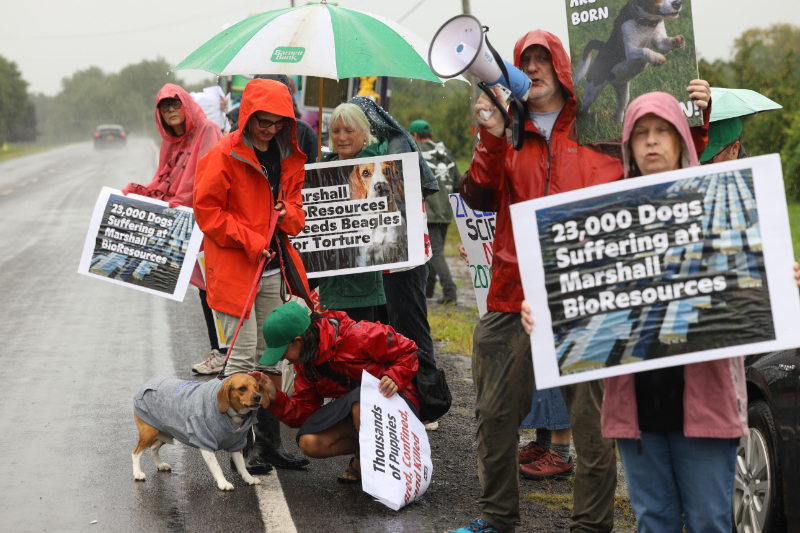
Animal-rights organizations are simultaneously escalating public pressure on Marshall and its customers, including a planned 207-mile march across New York scheduled to begin September 12 and conclude outside Marshall’s North Rose operation on September 26.
Whether that pressure produces a criminal investigation remains to be seen.
For now, the evidence falls into three very different categories, and they should not be confused.
There are documented facts: Marshall’s ownership structure, federal contracts, published research involving its animals, its large breeding operation and its past USDA regulatory history.
There are company claims: that its animals are humanely cared for, that recent USDA inspections were clean, that former-worker accusations are false, and that euthanasia because an animal cannot be placed is rare.
And there are new whistleblower allegations: accounts of animals being violently handled, dying during restraint, puppies dying in housing conditions and dogs allegedly suffering during euthanasia.
Those allegations now deserve evidence-based scrutiny from authorities capable of obtaining the records and testimony necessary to determine what actually happened.
Until that happens, calling Marshall guilty would get ahead of the facts.
Ignoring the allegations would do the same thing in the opposite direction.
Can’t We Do Better?
There is something deeply contradictory about where we find ourselves in 2026.
In New York, aggravated cruelty to a companion animal is a felony. Intentionally causing extreme pain to a dog or cat, or killing one in an especially depraved or sadistic manner, can send a person into the criminal justice system.
And most of us would agree that it should.
We have decided, as a society, that dogs and cats are not simply disposable objects. They feel pain. They experience fear. They form bonds. They trust us. We recognize that deliberately causing them extreme suffering is morally unacceptable.
But there is an exception written into the same law.
New York’s aggravated animal-cruelty statute specifically exempts properly conducted scientific tests, experiments and investigations involving living animals at approved laboratories and institutions.
That exemption does not mean laboratories are free to abuse animals. It does not excuse conduct outside legitimate scientific work, and it certainly does not establish that any of the allegations against Marshall BioResources are true.
But it does expose an uncomfortable contradiction.
We can prosecute someone for brutally hurting a dog in one setting while maintaining an enormous system in which thousands of dogs are bred specifically to become research animals in another.
At some point, we have to ask whether the distinction still makes sense scientifically—not just legally.
Because science itself is changing.
The FDA is now openly working to move away from animal testing as the default.
The agency is promoting what it calls New Approach Methodologies: human cell systems, organoids, organs-on-chips, computational toxicology, real-world human data and artificial intelligence.
The FDA has even created an artificial-intelligence research program for toxicology. One initiative, called AnimalGAN, is specifically being developed to create virtual animal models that can predict toxicological outcomes and reduce reliance on live-animal studies.
Think about that for a moment.
We now have computers capable of analyzing enormous collections of toxicology data, chemical structures, biological pathways, genetics, previous experiments and human clinical information at a scale no individual researcher ever could.
AI cannot replace every animal experiment today.
We should be honest about that.
There are still scientific questions for which validated alternatives do not yet exist, and replacing an established research method requires evidence that the replacement actually works.
But that is an argument for putting our scientific resources into developing those alternatives as fast as possible—not an argument for accepting the status quo indefinitely.
And in many areas, this is no longer theoretical.
The FDA says AI-powered models, computational systems, human organ-on-a-chip technology and advanced laboratory methods can already reduce or replace some animal testing. The agency is actively building a regulatory framework to allow drug developers to use those methods.
The technology is moving.
The science is moving.
Our thinking should move with it.
For decades, researchers used animals partly because there was no better way to answer certain questions.
That excuse becomes harder to make when better ways begin to exist.
If there ever was a job for artificial intelligence, this is it.
Use AI to model toxicity.
Use it to analyze decades of existing experiments.
Build digital biological models.
Use human cells.
Use organoids.
Use organs-on-chips.
Use the enormous amount of knowledge we have already accumulated instead of automatically repeating experiments on another generation of animals.
And invest aggressively in making those technologies better until experiments that once required a living dog, cat, monkey, rabbit or other animal no longer do.
We have already learned enough about animals to know that they suffer.
Maybe the next great scientific achievement isn’t discovering how much more we can learn from them.
Maybe it is discovering how to stop needing to use them at all.
The allegations surrounding Marshall BioResources still have to be investigated. Evidence needs to be examined. Witnesses need to be questioned. Marshall deserves the same presumption afforded to anyone accused of wrongdoing.
But the larger question exists regardless of what prosecutors ultimately determine about Marshall.
Why are we still doing this?
We know better than we did 50 years ago.
We have technology researchers 50 years ago could not have imagined.
We now have artificial intelligence capable of helping us solve extraordinarily complex problems.
So let’s give it this one.
Develop the science.
Build the alternatives.
Demand that government and industry use them whenever they can.
And where an animal is no longer necessary, leave the animal out of it.
Can’t we do better?
We can.
And by now, we should.
This story will be updated as additional government records, company responses or information from New York authorities becomes available.
Reporting note: This article was compiled from New York court records, USDA records, federal contracting data, peer-reviewed scientific publications, FDA documents, Marshall BioResources’ own public statements and the August 31, 2026 whistleblower report. Webs411 has distinguished throughout between documented records, company statements and allegations that have not been adjudicated.
